iPhone · Made for headphones
Ten minutes of something beautiful under your fingers.
Klang is an instrument you disappear into. Real handpan notes under your hands, a bed of sound that listens to what you play, and nothing on the screen that asks for anything.
Twenty beds under your hands
Under your notes lies a bed of sound, the backing. There are twenty, all made from the same recordings of the same steel, and every one gives way to your hands.
Harmony Tide Choir Lo-fi Pulse Deep
Soft chords that move where your notes point, never ahead of them.
RoomsHaze Nave Crypt
The whole instrument moves into a cathedral, a stone nave or the crypt below it. This is the echo.
Your own notesHeld Afterglow Phase Nebula Rewind
What you just played, held, slowed, scattered into a cloud or played backwards.
A floorStill Air Ground
A deep tone lying still under you, a floor for everything you play.
WeatherSurf Wind Swell
No notes at all: the sea and the wind, singing the chord under your hands.
Put your headphones on
Klang is made for headphones. In them the instrument sits in front of you in space, every field in its own place, the ambience has its low notes and its room. The speaker works, and the app mixes differently for it, but the speaker is the small version. If you try it once, try it in headphones.
Nothing can sound wrong
Every note is in the scale. The bed underneath only ever carries what your hands have already said, and it steps aside the moment a strike would rub against it. You cannot play a wrong note here, so there is nothing to get right. Sit with it for ten minutes, or an hour, and come out quieter than you went in.
It follows, it never leads
Play a couple of notes and a soft bed wakes under you: a drone that leans towards whatever you play most, and slow chords that follow your notes. It keeps out of the way when you play fast and dies away when you stop. It never plays a melody, never guesses a tempo, never asks to be listened to.
The bed is the same instrument: every backing is built from the same studio recordings, and several from the notes you have just played. Whichever you choose, it keeps a slow bar and changes chord only at the end of a phrase, where your notes have pointed.
Everything moves at the pace of breathing
The light under the surface breathes with the bed. The colours drift over a minute or two. Some backings bring their own sky: water rising and falling with the wave you hear, light falling from above in the stone room, a glow at each note that is still ringing, a light that crosses the sky when the chord changes. A strike lights the field and the light fades with the note. Nothing flashes, counts, pulses to a beat, or wants the eye. After a while the screen dims to a glow and lets you play by touch.
Nave: light falls from above, as in a stone room.Surf: the water rises and falls with the wave you hear, once every eleven seconds.Deep: one broad light moves over to each new chord, slowly.Your hands do all of it
- Strike harder and the note opens up and brightens. Softer is darker, like a fingertip instead of a knuckle.
- Strike near the rim for the thin, ringing edge of the note.
- Use the ball of the thumb on the two bass pads. The wider the contact, the heavier the strike.
- Rest a finger on a ringing field to hush it, as a hand on the steel would.
- Feel it. Each strike is a small body in the hand that fades with the note.
- Move. Shake the phone gently and a resonance sweeps across whatever is ringing, the way a hand waving just above the steel does; tilt it flatter and the air inside the shell swells and darkens, as if a hand were over the bass hole. Both can be switched off.
There are no buttons on the surface. Six fingers at once, and one small dot in the corner for the settings. Hold the left edge to change the theme, the bottom between the bass pads to change what plays under you, and the right edge for what you have saved.
Quiet by default
No account, no sign-up, no notifications, no ads, no streaks, nothing to buy inside it. The app never speaks first. Open it, and it is an instrument.
Make it a place of your own
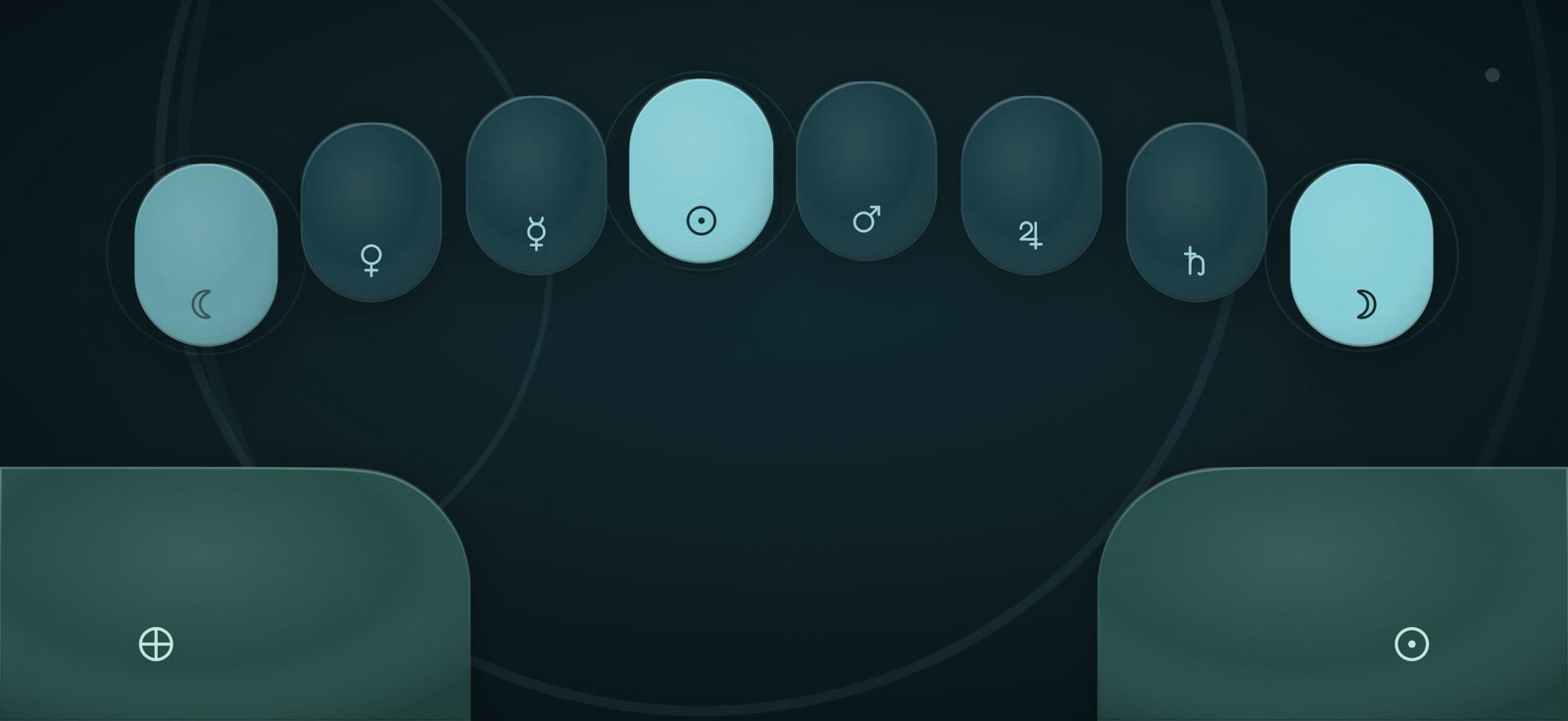
Three instruments to play: D Kurd, dark and the one most handpans are tuned to; D Celtic, open and bright; D Pygmy, pentatonic, where nothing can sound wrong even by accident. Ten themes, each one a place to sit rather than a poster: the soft light of Bloom, the still night of Moonlight, the warmth of Ember, the steel of Bronze, the clay of Terracotta, the dark water of Lagoon, the rings of Ripple, the eclipse sky of Umbra, the floating mist of Pollen and the moving light of Silk. The fields are made of something now: a dome of brushed steel or of matte cloth, lit from above, and the light rolls across them as you tilt the phone. Labels as the planets, as the eight trigrams or what they stand for, as note names, or none. Left-handed layout, width, haptics and motion, all in a panel that opens from the dot and lets the instrument keep sounding while you change things. Everything is explained on the support page.
For the handpan owner
It is honest enough not to embarrass the real one.
A3
Gu
D3
D3, and six fingers fall along the arc of eight fields from A3 to A4.- Every note is a studio recording of one twelve-field handpan tuned to D Kurd: several takes per note so repeats never sound identical, and five articulations, finger, nail, felt, hard rubber and muted, blended by how hard and where you strike. Nothing is synthesised in place of the steel.
- The layout is the grip. Eight tone fields,
A3toA4, in an arc that bows exactly where your fingers land when your thumbs rest in the corners; the Gu under the left thumb, the Ding,D3, under the right. Play without looking, the way you would on the steel. - The steel rings along. Strike a field firmly and the fields that share its overtones ring faintly with it.
- In headphones the instrument sits in front of you in spatial audio, every field in its own place.
- Touch-to-sound latency is under ten milliseconds on the phone itself. Bluetooth adds its own delay on top; wired headphones are the tightest, and AirPods are among the faster wireless ones.
Get it
Klang is coming to the App Store soon, for iPhone.
Requires iOS 17 or later. iPhone only. Questions or trouble: klang@zerolabs.se.