Support
Help
Common questions
- Do I need headphones?
- Klang is made for them. In headphones the instrument sits in front of you in space, the ambience has its low notes. The phone's speaker works, and the app mixes differently for it, but it is the small version of the thing.
- There is a delay between tapping and hearing the note.
- On the phone itself the delay is under ten milliseconds. Bluetooth headphones add anywhere from 100 to 250 ms of their own, which you feel as lag. Wired headphones have none of it at all, and among wireless ones AirPods are the fastest.
- No sound.
- Klang plays even with the ring/silent switch on, so check the volume buttons and whether audio is going to a Bluetooth device in another room. If another app has taken over audio, a hit on any pad restarts the engine.
- The screen will not rotate.
- Klang is landscape only and locks itself there, with the Dynamic Island on either side. It ignores the portrait lock in Control Centre.
- Soft taps do nothing, or every tap is loud.
- Strike strength is read from how much of your finger touches the glass. A flat, firm press reads as hard; a light touch with the tip reads as soft. On the two bass pads, play with the ball of the thumb, the pad where the thumb meets the palm, as on the steel: it gives the bass its weight. The app calibrates itself to your hands over the first few hits.
- The app asked for motion access.
- That is for the
Motionsetting: a shake or a tilt can shape the sound, read from the phone's own sensors. Declining only turns that off. Nothing about your movement leaves the phone. - Notes wobble when I move.
- A clear shake sweeps the sound on purpose, the way a hand waving above the steel does. Ordinary playing movement is below the threshold. Set
MotiontoOffin the settings if you would rather it never did, and tell us if it triggers too easily on your phone. - Which iPhones?
- Any iPhone running iOS 17 or later. iPad is not supported.
Settings
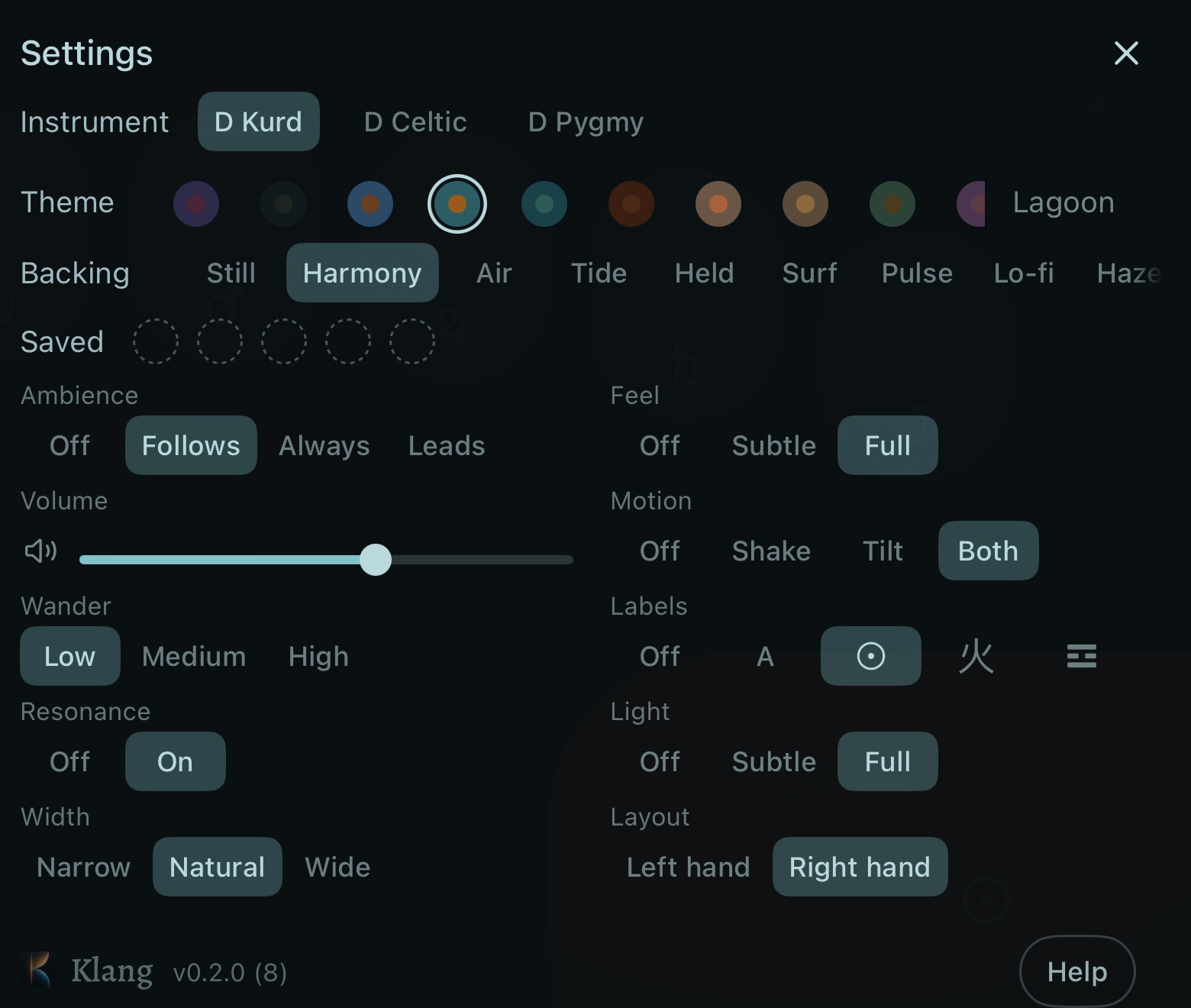
A small dot sits in the top-right corner of the play screen. Tap it and a panel slides in from the right. The instrument keeps sounding underneath, and the fields you can still see still play, so you set the background volume by ear. Everything applies the moment you touch it; there is nothing to save. Close the panel with the cross, a swipe to the right, the dot again, or a tap on the empty background beside the pads.
Theme
Instrument
What you are playing. A handpan cannot be retuned, so out in the world each tuning is its own instrument, and that is what the row is called. D Kurd is the dark one the app began with. D Celtic drops its B♭ and puts a C on top, which takes the pull downwards away and opens it up. D Pygmy is pentatonic, with nothing in it that wants to resolve, and the hardest one to play anything wrong in. Changing it changes the fields, and what lies under you follows: the bed only ever plays chords your instrument can hold. All three are laid out from the same recorded pan, which is explained below.
Theme
Ten looks for the instrument, shown as swatches: Bloom, Moonlight, Umbra, Lagoon, Ripple, Ember, Terracotta, Bronze, Pollen, a dark water with a mist floating on it that your strikes push aside, and Silk, light moving over cloth. Each has its own colours, its own material and its own way of answering a strike. Without opening the panel, hold the left edge of the screen to step through them (see From the edges). Hold a swatch a moment and drag it to put them in your own order; the same works for the row under it.
Backing
Backing
Still: a drone on D and A that leans towards whichever you play most.Harmony: the drone plus three quiet chord voices that follow your notes, moving between D minor, B♭, F, G minor, C and A minor. Under them lies a faint stream of deep noise, and if you have been still for a while, one note of the chord sounds by itself.Pulse: Harmony plus a frame drum that answers your hands: a low hit under the left bass pad, a softer one under a hard strike on the right, a bright tap on a rim or hard strike. It never plays on its own and never guesses a tempo, so it cannot be out of time.Air: the same sounds an octave down, slow, dark and far away. A plate rather than a tone.Lo-fi: Harmony heard through a narrow band with a little dust under it, like a radio in the next room.Haze: Air with your own notes answering from behind, and the whole instrument moves into a cathedral. A single note hangs for ten seconds and the next one arrives inside it.Tide: Harmony, alive. The bed swells and recedes on its own over half a minute, and its voices are tuned slightly apart so they shimmer against what you play.Phase: the bed's voices loop at different lengths and breathe on different cycles, so the whole never repeats and never quite changes. They only use notes you have played in the last half minute, so it is you, in slow motion.Held: no bed of its own. Whatever you strike keeps ringing as a long tone behind you, up to four notes at once, until you play something that rubs against it or a minute passes. The bed is your own chord and nothing else.Nave: the whole instrument moves into a stone room, not just the bed. Air lies underneath, without chords, and a deep sub on D and A beats slowly under it. One note is a room.Choir: Harmony, sung. The same sounds through two vowel shapes that slowly move between “oh” and “ah”, so the bed reads as voices rather than steel.Nebula: a cloud. Tiny grains of the notes you have played lately, scattered around you, thicker the more you play, over a faint drone. Unmistakably made of the instrument, and nothing like a note.Surf: no notes at all. Deep noise like the sea, breathing in and out over half a minute, tuned so the wave sings the chord under your hands. A chord change is the sea changing colour.Wind: a wind that behaves like wind. Louder is brighter, no two gusts alike, a whistle in the strong ones, and each gust passes across the room. It sings the last notes you struck, faintly.Rewind: the same sounds played backwards, so every note grows instead of fading. The bed arrives rather than dies away.Ground: D and A an octave under the pan, held still. Made of the pan's own ring with the mallet taken out, each note sounding twice a hair apart, so it swells slowly against itself, about every ten seconds. On the phone's speaker, which cannot play that low, it sounds an octave up.Afterglow: every note you strike stays behind as that same held ring, comes in as the strike dies away, and fades over about forty seconds. Up to four at once, and a new note that would rub against one makes it give way.Swell: a wave every eleven seconds, four seconds in and seven out, of deep noise ringing on D and A and on the last notes you struck. It sleeps when your hands stop.Deep: Harmony's chords made of that same held ring and laid open and low, under the pan instead of among its fields: the root, the fifth above it, and the third an octave higher, over Ground's floor. The chords follow your notes exactly as in Harmony.Crypt: the room under the nave, and a small one where the nave is tall. Everything above 300 Hz is taken off, the walls are close, so a note comes back off the stone at once instead of ringing on, and the deep sub is heavier. The floor moves with the harmony: the sub slides to the chord's root. And it drips, once in a while, somewhere behind you. It takes ten seconds to arrive.
What moves behind the fields
The theme decides the colours and the fields; some backings decide what moves behind them, drawn from the same numbers that shape their sound. In Surf and Swell a band of lighter water rises and falls with the wave you hear. In Nave light falls from above and brightens as the bed wakes. In Held and Afterglow each held note is a light at the field you struck, fading as the note fades. In Deep one soft light stands over the chord's root, cooler in minor and warmer in major, and crosses the sky when the chord changes. The other backings leave the theme's own slow drift as it is. Light sets how much of this you see, and Off turns it off.
Sound
Ambience
How much the bed does by itself. Off is silence. Follows wakes it after a couple of notes, keeps it out of the way when you play fast, and lets it die away after you stop. Always keeps it going whether you play or not, moving only where your notes point. Leads keeps it going too, and after about a quarter of a minute without a note it begins to move through its chords by itself, one change every other phrase, the way weather turns while nobody is watching. The first note you play hands the lead straight back. It never moves against you while you play, and it works the same under every bed in the Backing row.
Volume
How loud the ambience is against the instrument. It starts a little over halfway, at the level the bed was tuned for, so there is room to raise it as well as lower it. Remembered separately for the phone's speaker and for headphones, because the speaker cannot make the low notes of the drone and the bed is mixed differently there. Turn it down on the couch and it stays where you left it in your AirPods. The small symbol beside the slider shows which one you are setting: the speaker, headphones, or your AirPods or Beats by model.
Wander
How freely the harmony moves. Low follows you closely and changes chord only when another clearly fits better. Medium and High re-think more often and choose more freely among chords that fit about as well, so the bed surprises you now and then.
Resonance
Whether the fields that share overtones with the one you strike ring along faintly, the way steel does: the low D through D4 and A3, A3 through A4 and E4. Soft strikes wake nothing. Off silences it.
Width
How wide the instrument sits in headphones. Natural is a handpan on your lap. Narrow is almost one source with a hint of left and right. Wide spreads the fields across the room. The two bass pads stay near the middle in all three, because on the instrument the low note is the centre and the bass hole is underneath.
Touch
Feel
What the hand feels. Full is a light attack followed by a short body that fades with the note, longest on the two bass pads, almost nothing in the small high fields. Subtle keeps the attack only, at half strength. Off is nothing. Fast rolls are held to a few taps a second so the motor never turns into a buzz.
Motion
Whether moving the phone changes the sound. Shake sweeps a resonance across whatever is ringing when you give the phone a clear shake, the way a hand waving just above the steel does on a real pan; ordinary playing movement is below the threshold. Tilt is the other hand, the one under the instrument: tilt the screen away from you, flatter, and the air inside the shell falls and damps the way a covered bass hole does, the instrument darkens, and the room grows around it; tilt it towards you and the shell rings more openly, the sound brightens and the ambience comes in dry and close. Hold a tilt and it counts for a while, then the app accepts the new angle as yours; change posture between phrases and nothing happens at all. Lying on a sofa is fine. Both is shake and tilt together. Off stops reading the sensors altogether.
Look
Labels
What is written in the fields. Off writes nothing. Notes writes the note names (A3, B♭3 and so on). Planets gives each note a planet of the classical music of the spheres, with the Sun on the right bass pad and the Earth on the left. Trigrams gives each note one of the eight I Ching trigrams, the same one for the same note in any octave, with Earth on the left bass pad. Nature writes what each trigram stands for as a single character: earth, mountain, water, wind, thunder, fire, lake and heaven.
Light
How much moves. A field when struck, on top of what the theme does: swelling, rings, a halo. And the ground behind the fields: the theme's slow drift, or the backing's sky. Full is all of it as designed, Subtle about a third with a single ring, Off only the colour change of a struck field, and no motion when the fields arrive at a start or settle on a change of theme. If your phone is set to reduce motion, start with Subtle.
Layout
Left hand or Right hand. Left mirrors the instrument so the low D sits under the left thumb and the scale runs from right to left. On the real instrument there is no handedness, you simply turn it; here the arc is fixed, so this is the turn.
Places
Keeping a place
What you save is a whole setup you come back to: the theme, the backing, the ambience, resonance, width, wander, labels and light, all at once. Not the volume, feel, motion or layout, which stay as they are. The Saved row below has five rings. Tap an empty one and the setup you have now is kept there. Tap a full one to come back to it. Hold a full one and let go to overwrite it with what you have now. Hold and drag to put them in another order, or drag one past the end of the row onto the cross that appears there to remove it. Each is named by what it is, Umbra · Haze, and when you come back to one its name shows at the end of the Saved row. Its ring is the theme's colour with the small symbol of its backing in the middle: a line for Still, a wave for Tide, a fermata for Held, a spiral for Rewind, an arch for Nave, and so on. Saving setups is free, in every version: what you save is your own work.
From the edges
Three things can be changed without opening the panel, each from its own edge of the screen. Hold a finger still on the edge for a second until you feel a knock, then drag; each step is another knock, and what you are on changes under your finger as you go, with its name in the middle of the screen while your finger is down. Let go and it stays.
- The left edge steps through the themes: drag down for the next, up for the one before.
- The bottom, between the two bass pads, steps through the backings: drag sideways.
- The right edge steps through what you have saved, the same way as the left. With nothing saved it answers with a knock and nothing more.
A finger that rests on an edge while you are still playing does not count: the hold starts when the instrument has been quiet for a moment, so a thumb resting there through a phrase never changes anything.
Price
Everything is included
Klang is bought once on the App Store, and everything is in it: all three instruments, every theme, every backing, every setting. There is nothing to buy inside the app, no subscription and no account, and Family Sharing is on. Purchases follow your Apple ID, so Klang installs on a new phone without paying again.
Tips
A line of text at the bottom
Now and then, in a pause, a short line appears at the bottom of the screen and fades: the dot, headphones, damping, the rim, striking harder, the ball of the thumb, the three edges, shake, tilt. Never more than one per start, and only after two notes and eight seconds of stillness. A tip is done once you have done the thing it points at: opened the panel, played a minute in headphones, hushed a field, struck near the rim, struck both hard and soft, struck a bass pad with the ball of the thumb, changed the theme, the backing or a saved setup from its edge, shaken the phone, tilted it. Until then it may come back another day, at most five times in all. When they are all done, the app is silent for good. The settings dot also breathes for the first minute after each start until the panel has been opened once.
On the surface
Damping
Rest a finger on a ringing field without sliding and, after a third of a second, the note darkens and settles to a quarter of its level, the way a hand on the steel chokes it. Lift and it rings out on its own.
Reporting a problem
Write to klang@zerolabs.se with what you did, what you expected, roughly when it happened, and your iPhone model. If something sounded wrong, attach klang-log.txt: in the Files app, under On My iPhone, Klang. The app writes down what it was doing, and that file says more than any description can. It holds nothing about you, only what the sound engine did.
Tuning and the recordings
Everything you hear is one instrument: a twelve-field handpan tuned to D Kurd, recorded field by field. The library holds D3, A3, B♭3, C4, D4, E4, F4, G4, A4, C5, D5 and F5, each in several articulations and several takes, so a repeated note is never the same recording twice. The drone and most beds are built from mallet rolls on the same instrument. Ground, Afterglow and Deep are built from the soft mallet takes instead: a third of a second just after the strike is held for ever, every overtone kept at its own pitch, so what you hear is the pan's own ring with the mallet taken out. The frame drum in Pulse is a separate recording, and the Gu, the low breath from the underside, is the one sound not recorded: it is built from the D3 takes an octave down with a short synthesised thump underneath.
The three scales are three ways of laying out that one pan. D Kurd uses its nine original fields, D Celtic swaps the B♭ for the C above, and D Pygmy leaves out both the B♭ and the E and adds the two top fields. Nothing is pitch-shifted: every field is the note it was recorded as.
That also sets the limit. A handpan can only sound the notes it was hammered for, so the recordings hold seven pitch classes, D E F G A B♭ C, which is D natural minor, and D3 is the only low note. Every scale Klang can offer is therefore rooted on D. Anything else, F Low Pygmy or C♯ Annaziska or a major scale, needs another instrument recorded.
The recordings are in the public domain, dedicated under Creative Commons CC0. We do not know who played the instrument or who made it, so we do not claim to.
Contact
Write to klang@zerolabs.se. You will get an answer from the person who built the app.